If you’re preparing forJEE Main 2027, one question is probably on your mind: Which Physics chapters carry the most weightage in JEE Main? Knowing the JEE Main Physics chapter wise weightage 2027 can help you study smarter, prioritize high-scoring topics, and improve your overall percentile.
In this detailed guide, we’ll discuss the expected JEE Main Physics chapter wise weightage 2027, the chapters that deserve special attention, and how you can prepare effectively to maximize your score.
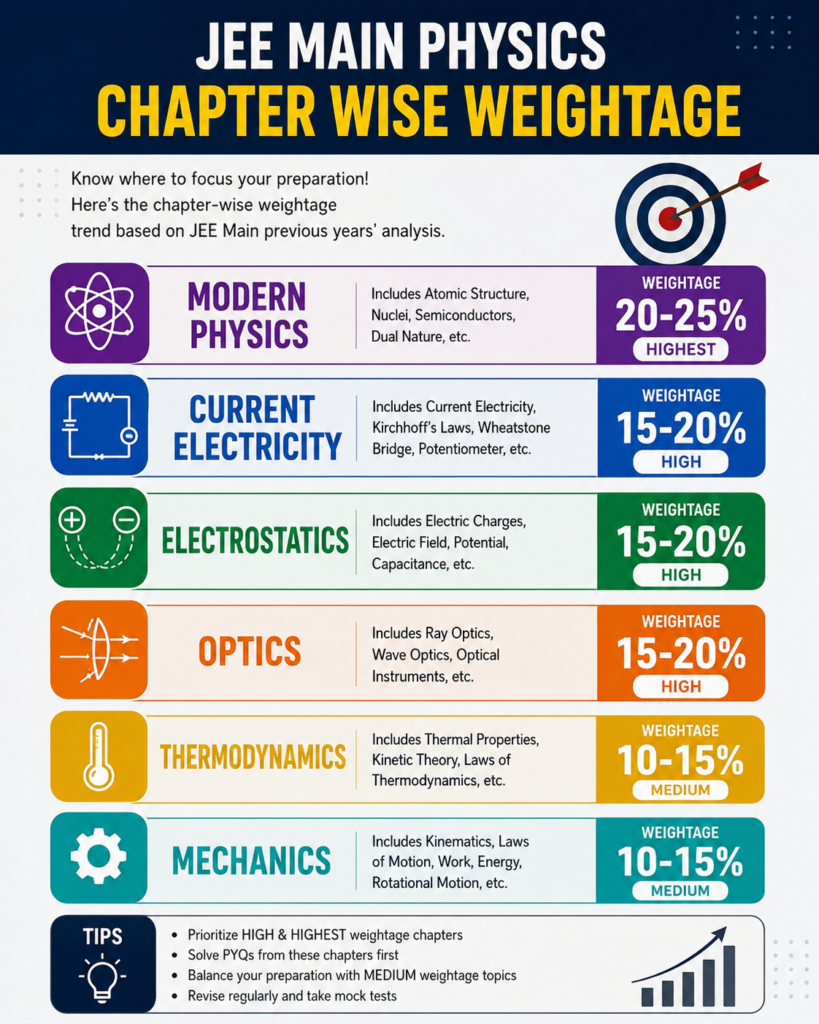
JEE Main Physics Chapter Wise Weightage 2027 – Expected marks distribution based on previous years' analysis. Use this infographic to identify high-weightage chapters and plan your preparation effectively.
JEE Main Physics Chapter Wise Weightage 2027 (Expected)
Based on the analysis of previous years’ JEE Main papers, the following chapters are expected to have higher weightage in the 2027 examination. Although the National Testing Agency (NTA) does not officially release chapter-wise marks distribution, the trends remain fairly consistent every year.
Physics Chapter
Expected Questions
Expected Marks
Current Electricity
1-2
4-8
Electrostatics
1-2
4-8
Ray Optics
1-2
4-8
Wave Optics
1
4
Modern Physics
2-3
8-12
Semiconductor Electronics
1
4
Magnetism & Moving Charges
1
4
Electromagnetic Induction
1
4
Alternating Current
1
4
Thermodynamics
1
4
Kinetic Theory of Gases
1
4
Oscillations & Waves
1
4
Rotational Motion
1
4
Work, Power & Energy
1
4
Laws of Motion
1
4
Gravitation
0-1
0-4
Units & Dimensions
0-1
0-4
Experimental Physics
1
4
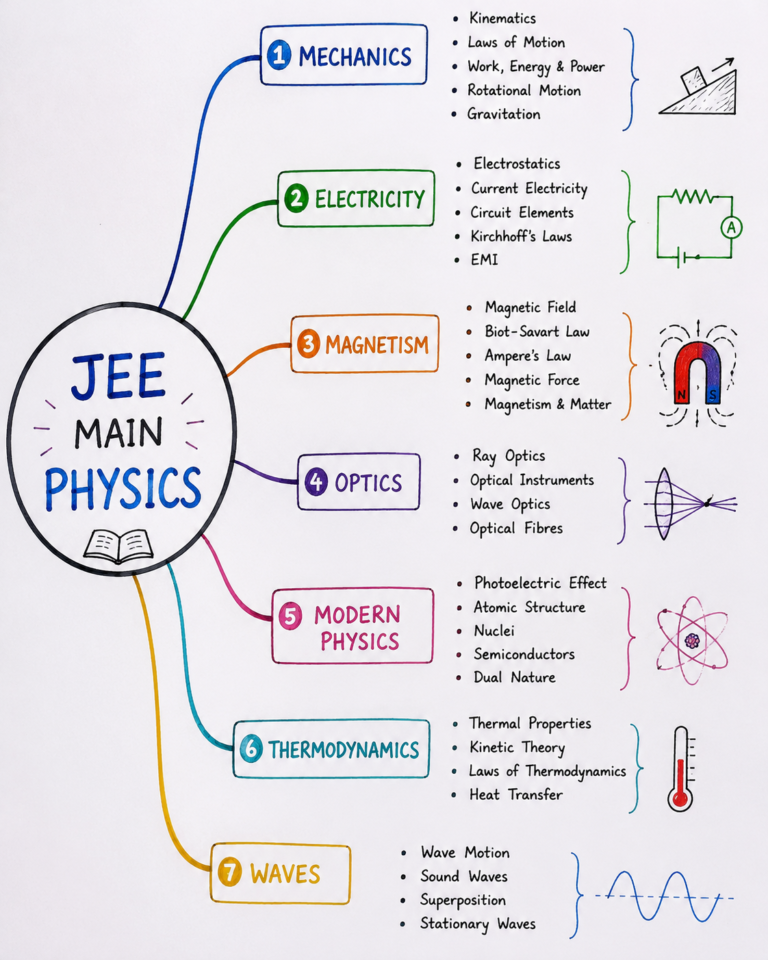
JEE Main Physics syllabus mind map covering the most important chapters and key topics to help students prepare strategically for JEE Main 2027.
Important Topics Within Each Chapter
Preparing only the chapter is not enough. You should focus on the concepts that are repeatedly tested in JEE Main.
For Modern Physics, concentrate on Bohr’s theory, radioactive decay, photoelectric effect, de Broglie wavelength, and nuclear reactions.
In Current Electricity, master Kirchhoff’s laws, drift velocity, potentiometer, Wheatstone bridge, and equivalent resistance.
For Electrostatics, practice electric field, electric potential, Gauss’s Law, capacitance, and energy stored in capacitors.
In Ray Optics, pay special attention to mirror formula, lens formula, refraction, total internal reflection, and optical instruments.
For Thermodynamics, understand the first law of thermodynamics, Carnot engine, heat transfer, and thermodynamic processes.
The more numerical problems you solve from these topics, the more confident you’ll become in the actual examination.
How to Prepare Physics According to Chapter Wise Weightage
The smartest way to prepare for JEE Main Physics 2027 is to combine chapter-wise weightage with concept-based learning.
Instead of randomly studying different chapters every day, begin with the high-weightage topics. Complete their theory first, make concise notes, memorize important formulas, and then solve a large number of numerical questions. Once you become comfortable with these chapters, gradually move toward medium-weightage topics and finally cover the remaining syllabus.
Remember that JEE Main is not just about theory. Nearly every question is concept-based and requires proper application of formulas. Therefore, solving previous years’ question papers and mock tests is just as important as studying theory.
Regular revision is another key factor. Many students finish the syllabus but forget important concepts because they do not revise consistently. A weekly revision schedule can make a significant difference in your final score.
Common Mistakes Students Should Avoid
Many aspirants spend weeks studying difficult chapters while ignoring easy scoring topics like Modern Physics or Semiconductor Electronics. Others keep reading theory without solving numerical problems, which often leads to poor performance in the examination.
Another common mistake is avoiding mock tests until the last month. Regular mock tests improve speed, accuracy, and time management—three factors that directly influence your JEE Main rank.
Finally, don’t rely only on shortcuts or formula sheets. Understanding the concept behind every formula is what helps you solve unfamiliar questions confidently.
Q2. How many questions are asked from Physics in JEE Main? The Physics section generally contains 25 questions, out of which candidates attempt according to the latest exam pattern. Always check the official notification for any changes.
Q3. Can I score 90+ marks in JEE Main Physics? Yes. With a strong command of high-weightage chapters, regular practice of numerical problems, mock tests, and consistent revision, scoring 90+ marks is achievable.
Q4. Is NCERT enough for JEE Main Physics? NCERT is excellent for building fundamentals and is particularly important for Modern Physics and Semiconductor Electronics. However, for numerical practice and conceptual depth, books like HC Verma and previous years’ JEE Main papers are highly recommended.